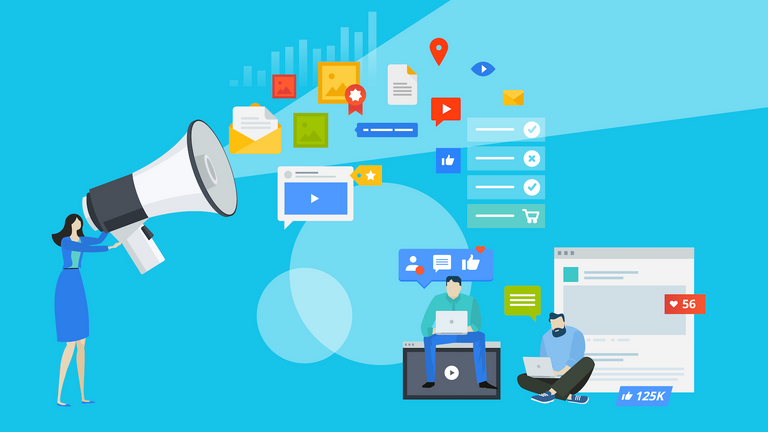
Marketing automation (not to be confused with software and remarketing)- a key technology that allows you to scale many modern marketing practices, such as segmentation, lead generation (generation of potential customers), evaluation of potential customers, relationship marketing, cross-selling and much more. Many modern businesses in the B2B and B2C segments of the US market have implemented marketing automation to manage their valuable customer relationships in real time.
Despite the increased popularity in recent years, marketing automation is not a new concept. According to Google Ngram Viewer, the term began to gain momentum in the late 1990s, during the same period, when there was the dot-com boom. The development of this direction has led to an increase in the number of suppliers offering tools for marketing automation, including Annuncio, Broadbase, Epiphany, current, Paragren, Revenio, SAS, Siebel and UNICA, and that's not all. After the bubble burst, only a private SAS became an independent supplier. In the mid-2000s, marketing automation became a hot topic again - much more relevant than before - and spawned a new generation of vendors such as Yeloguya (now part of Oracle), InfusionSoft, and Marketo (part of Adobe now). This was probably due to the following three trends:
Trend №1: Changing consumer behavior has forced companies to change their marketing and sales tactics
Before the advent of the Internet and social networks, consumers relied on sales representatives to obtain the information they needed to make an informed purchase. When consumers gained access to information on the Internet, they were able to postpone interaction with sales representatives until they knew as much as the seller (or even more). For example, consumers ' approach to buying cars today is very different from what it was just ten years ago. Today, many buyers will not go to the salon until they understand what kind of car, model and purchase price they are looking for.
This shift in power distribution meant that marketers had to play a larger role in the revenue generation process, maintaining relationships with "independent" consumers until they were ready to buy. But this solution posed its own problem – a problem of scale. Working to manage individual conversations with hundreds of thousands - even millions - of potential customers is what made marketing automation platforms so important in the mid-2000s. Then there was literally no other way to keep up with the demands of modern marketing. As well demonstrated Lucille ball at the candy factory, attempts to implement such massive processes without the right systems quickly lead to major riots and missed opportunities.
Phil Fernandez, the former CEO of Marketo, wrote in his 2012 book: "In a business of any size, especially in a company with an active presence on the Internet and social networks, interactions with customers can amount to thousands, millions or even hundreds of millions. Without the right tools to automate planning, implementation, and measurement, even the most hard-working marketer can be baffled by the complexity of the processes."
Trend №2: Increasingly shrinking budgets have changed companies ' approach to revenue generation and valuation
While some organizations are going through difficult times financially and as a result are reducing resources and staff, the leading companies recognize that growth is their key not only to survival but also to prosperity. By reorganizing their processes and investing in marketing automation technologies, these companies were able to increase sales and revenues, even with budget cuts. They refuse to put up with the widespread inconsistency between marketing and sales departments and traditional measurement tools such as spreadsheets.
Marketing automation tools also enabled marketers to measure the effectiveness of their marketing investments, which became critical when the digital channel raised measurement expectations (in touchpoints). With new tools, marketers can determine what works and what doesn't, and then strategically reallocate their resources to achieve higher profitability.
Trend №3: new software delivery model opens access to automation tools
Unlike previous generations of marketing automation software, today's solutions are available through the software-as-a-service (SaaS) delivery model, meaning marketers can access the tools they need in the browser almost without IT support.This also means that the instruments can be purchased on a periodic subscription basis, so marketers can pay for them using operating budgets rather than making capital investments.
These two factors were critical to the growth of marketing automation. Since marketing is unfortunately seen as a cost center in most companies, it was extremely difficult to get financial support from IT-decision makers to buy traditional solutions. By allowing companies to buy software for marketing automation, and many other services - by subscription, SaaS suppliers have eliminated the biggest obstacle to widespread distribution.
During an accelerated course on marketing automation in 2012, Carlos Hidalgo, co-founder of ANNUITAS, said: "This is the first time in the history of B2B marketing that marketers are responsible for buying and managing their own technology."
Marketing automation for all
With the development of the marketing automation industry, companies from all sectors have bridged the gap to join the pioneers who understand technology. Today, even traditionally conservative and pragmatic companies use marketing automation - which has led to the phenomenal growth we see today.
Kevin Lindsay, product marketing Director at Adobe, wrote in his 2017 blog, " Why automation is Your strategic advantage in personalization wars": "Using artificial intelligence and machine learning to create the right and accurate consumer experience and automate scaling, brands can control simultaneously such complex buying paths that far exceed the capabilities of human marketers."
Translation and adaptation of Lizzie funk's article.